AI Search Optimization for E-Commerce
Ecommerce SEO agency
A shopper tells an assistant what they want, the product, the use case, the constraints, and the model hands back a short list of brands to consider. Your store is either on that list or the shopper never learns it exists. A shopper cannot choose against a brand they were never shown, and whether your brand gets named turns on what the model can read about it.
Work with us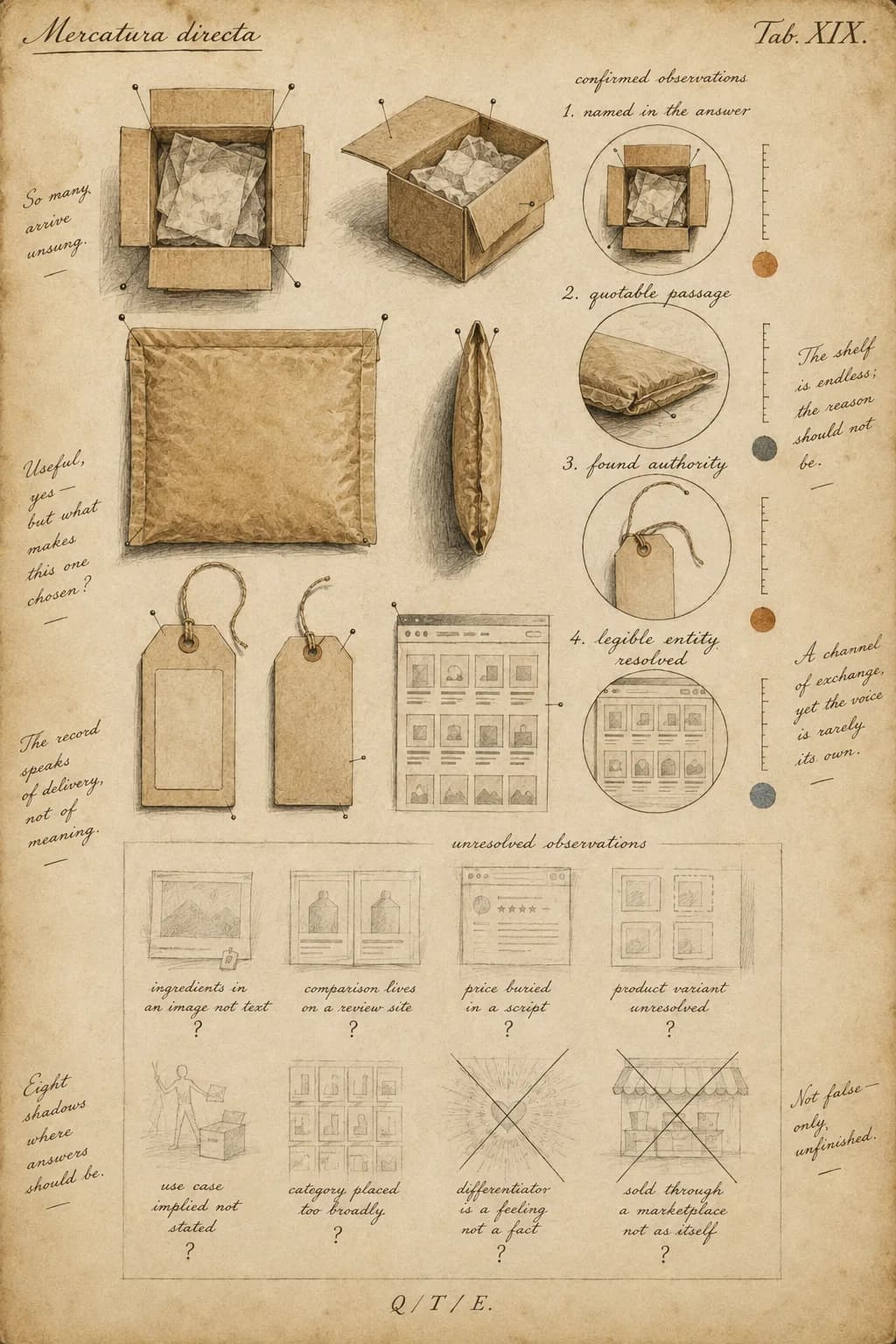
The confirmed specimens are the product facts an assistant can read and will use in a recommendation. The unresolved sketches are the details it cannot parse, ingredients locked in an image, a price loaded by a script, a differentiator written as a feeling instead of a fact, a product sold through a marketplace where the platform gets the name. The margin note asks: the shelf is endless, the reason should not be.
How AI search works
01 · CONVERSATION
View transcript
The AI visibility gap
Shoppers ask AI what to buy.
The product search moved. A shopper describes what they want, reads back the brands the assistant returns, and clicks through to the ones it named. The two figures on the right measure how far into shopping AI has already reached.
The brands the model can read get recommended and get the cart. The ones it cannot parse never reach the short list the shopper sees.
44%
of US online shoppers mostly start their product search in an LLM or split their search between AI tools and traditional search engines.
Bain and Company, "Your Next Customer Will Find You Using AI. Now What?", published April 7, 2026. Bain Generative AI US Consumer Survey, n=1,500, fielded September 2025. Vendor research: Bain sells consulting.
35%
of shoppers say they have already used generative AI guidance while shopping.
Coveo with Arlington Research, "Shoppers Say Yes to GenAI This Holiday Season," released September 11, 2025. n=6,000 adult consumers in the US, UK, Australia, and New Zealand, fielded June 2025. Vendor research: Coveo sells commerce search software.
Why AI skips your product
Three reasons AI doesn't name your product.
GAP 01
The model recommends products it can compare. Yours has to be legible.
A shopper asks for the best option with three constraints. The assistant reads product pages, pulls the ones where the specs, the ingredients, the use case, and the price are in text it can parse, and hands those back. If your product page carries that information in an image, a script, or a mood rather than a sentence, the model cannot compare you and does not try.
GAP 02
Your differentiator is written as a feeling where a fact would do.
Best-selling. Award-winning. Loved by thousands. The model cannot cite any of those. It can cite what you are made of, what you do that the next closest product does not, and which use case you fit. The brand whose difference is a checkable fact gets named. The one whose difference is an adjective does not.
GAP 03
You sell through a marketplace and the marketplace gets your name.
When the assistant retrieves a marketplace listing, the citation goes to the platform. You appear as inventory inside someone else's answer, same as a hotel on an OTA or a tour on a booking site. Brands that also have their own readable product pages show up as themselves, which is the difference between being recommended and being resold.
The model names the brands whose products it can read, compare, and place in a category. A product the model can read, compare, and place is a product it can name. Getting yours into that set is the whole task.
What we do
SEO and AI search services for online and DTC brands.
A shopper gives the assistant three constraints and it compares the products whose specs, ingredients and uses it can read. AI SEO / GEO →
Sold through a marketplace, you appear as inventory inside someone else's record, and the assistant treats the marketplace as the source. Entity SEO →
Best-selling and loved by thousands cannot be checked. What it is made of and what it does that the next option doesn't can. Answer Engine Optimization →
Product facts written as passages on your own pages, so the comparison has something of yours to work from. Citation-Ready Content →
Shoppers search TikTok and YouTube for the product in use. A clip shows it. It doesn't say what it's made of. Social Search Optimization →
Which product questions name your brand and which hand the shopper to a marketplace. The map comes before the fix. Context Map →
Where we work
The cart ships anywhere. The brand still answers from one place.
FAQ
Questions ecommerce brands ask
We get most of our sales from Amazon and our own site already works fine. Why does this matter?
Amazon works, and it works for Amazon. When a shopper asks an assistant for the best product in your category, the model draws from what it can read across the web. If the richest description of your product lives on Amazon, the recommendation names Amazon and your brand appears as inventory inside their answer. Your own site is where you show up as yourself, with your name on the citation rather than the marketplace's. Both channels work. Only one of them builds your entity.
We have a marketing team running ads and content. They don't know anything about AI search. Do you work with existing teams?
Yes, and that is the usual shape of it. A capable marketing team running paid, email, and content, where nobody has had a reason yet to learn how AI recommendations get assembled. We do the parts that need the specialized knowledge, product entity structure, comparison content the model can read, and measurement, and we hand back the reasoning so your people can carry it. The goal is that your team can run this without us.
Our product pages already have all the details. Why isn't that enough?
It depends on where the details are and what form they take. Ingredients in an image. Specs in a dropdown that loads after the page. Price in a script the model cannot execute. Variant differences explained nowhere. The details exist, but the model cannot read them in the format they are in. The fix is making the information you already have legible in text the model can parse and compare against a competitor's.
How do we know if any of this moved?
We build a set of product and category queries the way shoppers ask them, the product type plus the use case plus the constraints, and run them across the assistants on a schedule. Then we track whether your brand appears, for which products, and against which competitors. The measure is whether the model names your brand when a shopper asks for what you sell. Traffic is a separate question. Here is how we measure whether shoppers find your brand.
We have hundreds of SKUs. Does every product page need to be optimized?
No. Start with the products that matter, the ones you want to be known for, the ones where you have a differentiator, and the ones where a shopper is most likely to ask an assistant for a recommendation. A brand with five legible hero products beats a brand with five hundred pages the model cannot parse. Depth on the products that matter is worth more than breadth across a catalog.
We're a small DTC brand nobody has heard of. Is this only for big brands?
Small brands often do better here. The model matches a product to a question instead of ranking by market share, and a specific brand that clearly fits one use case is easier to recommend than a large brand that claims to fit every use case. If you are the obvious answer to "best X for Y under Z," legibility decides it before name recognition does.
How long before an assistant starts recommending our products?
We don't promise a timeline, because the systems don't publish how often they re-read a page. What we can tell you is the order things move in. Presence comes first, whether you appear at all for your core product queries, once the product facts, the differentiators, and the comparison points live in text the model can read. Accuracy comes after, whether it recommends the right products from your line, because that depends on third-party sources and review content catching up. Watch presence first.
Find out where your store stands.
Tell us about the store, and the first conversation starts from whether an assistant names your brand when a shopper describes what you sell. If you want that picture before committing to anything, the Context Map is a fixed-scope read that shows it.