AI Search Optimization for Manufacturers
Manufacturing marketing agency
A procurement team looking for a supplier often does not start with a list of shops. They describe the job to an assistant, powder coating for OEM parts, fabrication at volume, a coating line near the plant, and the assistant hands back a few names. Those names get the RFP. If the model does not connect your shop to the capability they searched for, you are not losing the bid. You are never asked to quote it.
Work with us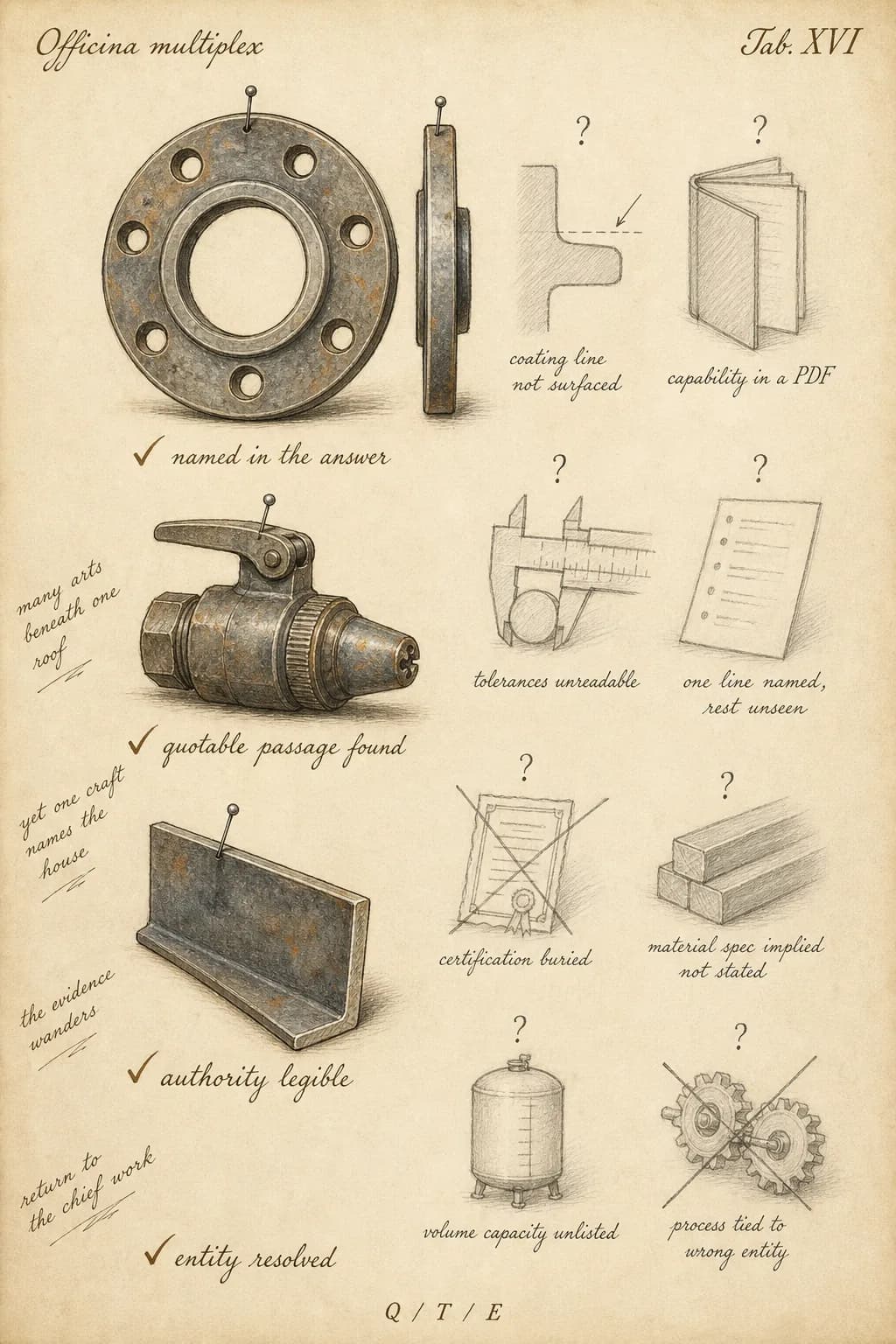
The confirmed specimens are the capabilities a model has tied to your shop and will name in an answer. The unresolved sketches are the capabilities it cannot read, buried in a PDF, implied in a spec, or attached to the wrong entity, so a buyer searching for that work never finds you. The margin note reads: many arts beneath one roof, yet one craft names the house.
Watch
How buyers find manufacturers with AI
Ben Puzzuoli runs a real sourcing request through an AI assistant and shows how a shop misses the shortlist. Two minutes fifty.
Read the transcript
Transcript
Coating, stamping, tooling, fabrication. Someone's looking for one of these shops right now. The question is, will they find them? Here's how the search works.
"Did we ever find a coater for that rack line?" "Not yet. Give me two minutes. Copilot, I need a powder coating supplier for OEM aluminum server rack panels. High volume, ideally one who can also do fabrication within about an hour of Windsor."
That's how your buyers find companies now. They just ask their assistant. It used to be that they would Google it, find ten links, one website with ten shops, they would include someone they knew, and done. Now they describe the job to their assistant, get one answer with three companies in it. Their shortlist is done before they even pick up the phone. Forty seconds, three companies. Everyone else didn't lose the bid. They didn't even know about it.
Let's understand what it did with what I just typed. It doesn't search for that exact sentence. Instead, it breaks it down into multiple sentences. The material, the process. Can one shop do both? Where are they located? It then comes back with the names. So for your company to be part of that answer, AI needs to be able to validate all those sentences and questions. Miss one answer? You're not ranked low. You're out. Same query in ChatGPT and Gemini produce a similar shortlist to Copilot's.
So why do some shops come up and some don't? It's not the size. It's not how good you are. Most of these shops here will do better work than the answers that were given. It's language, and it's not just your website. The models don't just check one site. They check everywhere your company is listed online. Your Google profile, your LinkedIn, social media properties, trade publications. Even when you are mentioned in the local newspaper. And that's your record.
Most shops haven't checked theirs. Half their information is five years old and half of it's in a language that can't be searched. Your capabilities are stored in your head, on your shop floor, in a PDF that someone created in 2016. All in formats that AI can't read, and AI can't recommend you to buyers. So you get skipped and you don't know. And that's the work. We fix your record anywhere the machine will look and not just on your website.
I'm standing here in Oldcastle, Windsor, but this video has nothing to do with Oldcastle or Windsor. Same problem in Michigan, same problem in Ohio, same problem in Texas, Germany, Mexico. All buyers follow the same process. They use AI. And when AI can't understand your records, it excludes you from the answer. This isn't a scare tactic. Your competitors are getting RFQs that you never saw.
Don't take my word for it. Go try it yourself. Open up your AI assistant and type in a question the way your buyer would when they're looking for your products. Do you show up? Because I know somewhere in this world, someone's standing in a doorway asking someone for two minutes, and you'll want to be part of that answer.
How AI search works
01 · CONVERSATION
View transcript
The AI visibility gap
Your buyers brought AI into the sourcing decision.
The sourcing search now often starts inside an assistant. A buyer describes the job, reads back the names that come out, and builds the shortlist from there. The two surveys on the right measure how far that shift has already gone.
Shops the model already ties to the work compound that position every time a buyer asks who can do the job. Shops it cannot read lose bids they never see, because the shortlist was set before the phone rang.
69%
of technical buyers use generative AI during the purchasing process. 31% never do, down from 42% a year earlier.
TREW Marketing and GlobalSpec with Elektor, 2026 State of Marketing to Engineers, released March 25, 2026. More than 1,100 engineers and technical professionals worldwide. The same buyers rate their trust in generative AI answers at 4.7 out of 10.
94%
of business buyers use AI somewhere in their buying process, and twice as many now name generative AI or conversational search as a more important source than did a year earlier.
Forrester, Buyers' Journey Survey, 2025, reported by John Buten, January 22, 2026. Global business buyers across industries. General B2B, not manufacturing-specific.
Why AI skips your shop
Three reasons AI doesn't name your shop.
GAP 01
The buyer searches for a capability and never types your name.
Procurement does not type your name. They type the job: the process, the material, the volume, the spec. Retrieval hands back the shops the model has firmly tied to that job. If it has not tied you to it, you are not in the set that gets considered.
GAP 02
What you can do lives where the model can't read it.
Tolerances in a capabilities sheet. Materials and processes in an equipment list. Certifications in a downloadable spec. That is where a buyer's real question gets answered, and it is the part of your site retrieval cannot parse.
GAP 03
You get named for one line and forgotten for the rest.
A shop that does coating, fabrication, and assembly gets tied to whichever line has the most public footprint. A buyer who needs one of the others never learns you offer it, because to the model you don't.
Every version of this is the same gap. The model has to connect your shop to the work before a buyer searching for that work can find you.
What we do
SEO and AI search services for manufacturers.
Procurement types the job, the process, the material, the volume, the spec, and the shops named are the ones whose capabilities are on record. AI SEO / GEO →
Your shop does coating, fabrication and assembly, and a model ties you to whichever one has the most public footprint. Entity SEO →
Tolerance, material and certification questions get answered from whoever published them, and the answer features don't open your spec sheet. Answer Engine Optimization →
Capabilities, tolerances, materials and certifications as readable passages rather than a downloadable PDF. Citation-Ready Content →
Buyers and engineers watch shop-floor video on YouTube, and that footage needs the written detail a system can use beside it. Social Search Optimization →
How much of your capability the assistants can see. Usually less than the shop floor would guess. Context Map →
Where we work
Buyers source by capability first and location second. We cover both.
FAQ
Questions manufacturers ask about AI search
Our buyers find us through RFPs and referrals. Why does this matter?
The RFP is still where the award happens. What changed is who gets on the list that receives it. Procurement and sourcing engineers now run an early research step before the RFP goes out, and a share of that step happens inside an assistant. If the model does not surface you when they describe the job, you are not on the list that gets asked to quote. The referral still works when it happens. The problem is the buyer who has no referral and starts by asking AI who can do the work.
We have an internal marketing team and a web person. They're out of their depth on AI. Do you work with existing teams?
Yes, and that is the usual shape of it. A capable marketing person and someone who owns the site, where neither has had reason yet to learn how retrieval and AI answers work. We do the parts that need the specialized knowledge, entity structure, capability content, and measurement, and we hand back the reasoning so your people can carry it. The goal is that your team ends up able to run this themselves.
We do a dozen processes. Does the model really only know one?
Usually, yes. A shop that runs coating, fabrication, and assembly tends to get tied to whichever line has the most public footprint, the one with the most pages, the most mentions, the clearest story. The model builds its picture of you from what it can read, and if eleven of your twelve processes live in a capabilities PDF or a single line on an overview page, they carry almost no weight. You know you do all twelve. The model knows the one you happened to write the most about.
How do we know if any of this moved?
We build a set of capability queries the way your buyers phrase them, the process plus the material plus the spec, and run them across the assistants on a schedule. Then we track whether you surface, for which capabilities, and against whom. The measure is presence in the answer for the work you do. Traffic is a separate question. Here is how we measure what the model knows you can do.
Our capabilities are all in downloadable spec sheets. Is that a problem?
It is one of the most common ones. A capabilities PDF, an equipment list, a tolerance table, a certifications sheet, these hold the exact detail a buyer's question turns on, and they are the part of your site retrieval reads least well. Keep the PDFs, and make the same facts exist in text the model can parse, on pages built around the capability instead of buried in a download. The spec sheet stays for the human. The plain-text version is what gets you retrieved.
We're a small job shop, nowhere near tier 1. Is this only for big suppliers?
Small shops often do better here. Retrieval rewards a clear, specific match to a specific question, and a shop that does two processes well for one kind of part is easier to tie to those processes than a large supplier who does everything for everyone. Scale buys footprint in traditional search. It matters less in a system looking for the cleanest answer to a narrow capability question. If you are the obvious answer to "who does X for Y," the match decides it before size does.
How long before an assistant lists all our capabilities correctly?
We don't promise a timeline, because the systems don't publish how often they re-read a page. What we can tell you is the order things move in. Presence comes first, whether you surface at all for a capability, once that capability lives in text the model can read on pages built around the work. Accuracy comes after, whether the answer describes everything you offer or one line, because that depends on third-party sources catching up to what you do. Watch presence first.
Find out where your shop stands.
Tell us about the shop, and the first conversation starts from whether an assistant ties you to the work when a buyer describes the job. If you want that picture before committing to anything, the Context Map is a fixed-scope read that shows it.